Notebook Entry
Movie Review on the legend of 1900
A few days ago, I watched a movie that is kind of old but classic, I believe, called The Legend of 1900 (1998), and I’m going to record some of my thoughts here.
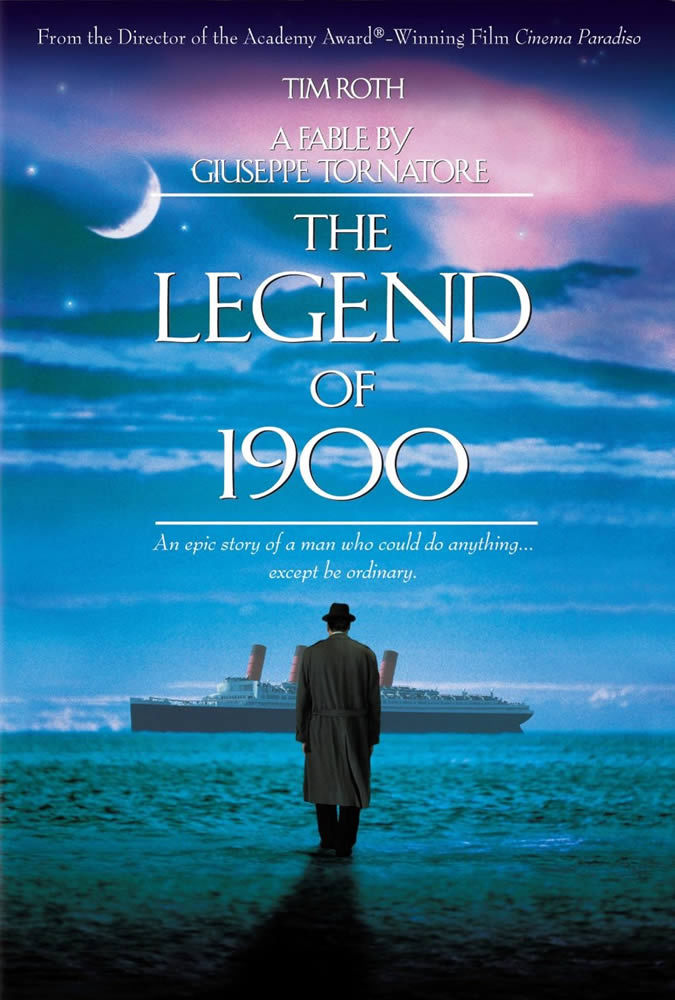
The plot is somewhat cliche: A musical genius abandoned as an infant on a ship called Virginia in the first month of 1900, grows to be an excellent pianist on the ocean, and falls in love with a girl but never dares to see her again due to the fear of the land, and finally ends up dying in a thunderous explosion of the decaying ship.
The audience gets to know this story through a trumpeter named Max, who left the ship before the World War II and later gets into financial trouble, having to sell his favorite instrument to make a living.
At first glance, I was attracted by the actor Tim Roth, who also plays Dr. Lightman in the TV series Lie to Me, where he showed a skillful performance that left a deep impression on me. In this movie, I was deeply touched again by the main character 1900, played by the same actor. Compared to the TV series where he shows the doctor’s expertise in the microexpressions and the kind of overconfidence that irritates people around him, 1900 is a juvenile who never sets foot on the land of industry and stays pure all his life, which makes me find him truly adorable. When he plays his piano for whether aristocrats or proletarians, he pours all his raw emotions into every note; even when his rival provokes him with flashy technique and arrogance, 1900 listens—not with resentment—but with tears in his eyes, moved by music itself before ego or competition. That is when I felt a strange envy for him—not for his genius, but for his sincerity, his unbroken devotion to something he truly loved. So when he refuses to get off of the ship and decided to perish with it, it was such a heartbreaking moment, especially when he tells the jokes about himself “hilariously playing the piano in the heaven with two right arms”, with his fingers hover gracefully over an invisible keyboard in the rusty cabin.
At the same time there are also some thoughtful scenes and lines for me. 1900 is too naive and shy to greet his loving girl, and he only dares to kiss her while she sleeps. When he finally decides to get down the ship, he stays on the gangway stairs, as if he were dizzy at the thought of getting down. Like what he always says, “Lose your sea legs?”, we all have our comfort zones and some place horrible for us, when we were challenged by them, it’s good to brave the elements, but it’s also okay to live the life we want and are suited for, only if we loved the world we live in.
Another interesting sentence is about 1900’s view of the relationship between the ocean and the land. The keys of a piano, he says, are finite—eighty-eight keys, and within them, an infinity of music. But the city outside stretches endlessly, like a keyboard without end. There are too many choices, too many roads, too much chaos. “Take me to the end of the world,” he says, “but not off this ship.” He is a master in his little world—but he knows he would be lost in ours. In a way, his piano is a metaphor for life: we cannot control the world, but we can choose the space we shape with meaning.
Another sentence is his attitude to something around: he shows great disrespect for both the regulations and the jazz. Maybe we all wanted to live a life with freedom and carelessness, but we are always constrained by the “regualtions”. Maybe we didn’t accomplished anything, and what we have done were vanished with the “ship”. Yet even so, when we face the end – like the “recording” being replayed, we also lived a life we imagined, loved someone/something we treasured, and we can proudly say, “fuck the world”.
When I was surfing the Internet, I saw someone suggest that 1900 was actually Max on the ship, and the whole story was imaginary. I have to say this kind of view made sense to me with their explanations, but I strongly wished 1900 had really lived once, since almost everyone had a 1900 in their heart. In a nutshell, the reality is not important, as long as “you have a good story and someone to talk to”.
Good night to all, and wish we can all be our own 1900 in the world!
- The following passage is polished by ChatGPT:
🌊 The Legend of 1900 — A Reflection
A few days ago, I watched a film that may be old, yet still carries a timeless glow—The Legend of 1900 (1998). Its lingering beauty compelled me to write down the thoughts and emotions it awakened in me.
The story, at first glance, may seem simple, even familiar: a musical genius, abandoned as an infant on a ship named Virginia at the dawn of the new century, grows up at sea and becomes a pianist of extraordinary talent. He falls in love with a girl whose face he never truly dares to know, and in the end, he chooses to remain forever on the ship that defined his world, perishing with it in a thunderous explosion as it sinks into oblivion.
We come to know 1900’s story through his friend Max, a trumpet player who once shared the stage with him. Years later, burdened by poverty and bitterness, Max tries to sell his beloved trumpet, but in the process he is drawn back into his memories—into that world of music, wonder, and a man who never set foot on land.
What first drew me to the film was the actor Tim Roth. I had seen him before as Dr. Cal Lightman in the series Lie to Me, where he embodied sharp insight and cynical intelligence. But here, as 1900, he becomes someone entirely different—gentle, innocent, untainted by ambition or vanity. There is something disarming in his purity, like a child hidden inside a man’s body. When he plays the piano, he gives himself completely to the music; you feel the raw emotion in every note. Even when his rival provokes him with flashy technique and arrogance, 1900 listens—not with resentment—but with tears in his eyes, moved by music itself before ego or competition. That is when I felt a strange envy for him—not for his genius, but for his sincerity, his unbroken devotion to something he truly loved.
And so, when he refuses to leave the ship, choosing instead to face death with quiet acceptance, the moment is devastating not because it is tragic, but because it feels true. In the ruined piano room, surrounded by the rust and dust of time, he jokes gently about himself—imagining he might play in heaven with two right hands—while his fingers hover gracefully over an invisible keyboard. That scene stayed with me: the beauty of a soul that has made peace with itself.
Yet beneath the poetry of the story lies a kind of philosophical reflection. 1900 is so shy that he cannot even greet the girl he loves; he only dares to kiss her hand while she sleeps. When he finally attempts to step off the ship—to touch real land for the first time in his life—he freezes halfway down the gangway stairs. Like he says throughout the film, “Lose your sea legs?” We all have our fears, our unseen walls. The world beyond our comfort zone seems vast, terrifying, endless. Sometimes courage means going beyond it—but sometimes wisdom is knowing when you belong to a different horizon. Perhaps it is not cowardice to remain where your soul feels whole.
One of 1900’s most memorable reflections comes when he explains why he cannot live on land. The keys of a piano, he says, are finite—eighty-eight keys, and within them, an infinity of music. But the city outside stretches endlessly, like a keyboard without end. There are too many choices, too many roads, too much chaos. “Take me to the end of the world,” he says, “but not off this ship.” He is a master in his little world—but he knows he would be lost in ours. In a way, his piano is a metaphor for life: we cannot control the world, but we can choose the space we shape with meaning.
He also shows a certain defiance toward the rules and expectations of society—toward what he calls “regulations”—and even toward jazz itself, as if nothing truly matters except honesty in what we create. Perhaps none of us will accomplish anything monumental. Perhaps we too will disappear one day, like his ship, forgotten by history. But even so—if along the way we loved something purely, if we were once moved beyond measure by a melody, a moment, or a person—then maybe that is enough. When the tape of our lives is replayed, we may still smile and say, like 1900, “Fuck the world.” Because we lived the life that was ours.
Some viewers believe that 1900 never existed—that he was only a figment of Max’s imagination, a dream crafted by a lonely musician who needed beauty in his life. I understand that interpretation, but I don’t want it to be true. I want to believe that 1900 once lived, even if only in a story. Because I think we each carry a 1900 inside us—the part of us that longs for purity, refuses compromise, and quietly guards its own private universe.
In the end, whether or not 1900 was real doesn’t truly matter. What matters is that Max had a story to tell—and someone willing to listen. Perhaps that is enough for any of us.
Good night to all—and may we each find the courage to be our own 1900 in this vast, uncertain world.