Notebook Entry
Reading notes for Modern Particle Physics, Mark Thomson (Chapter 1)
These days I’m reading the modern particle physics by Mark Thomson, and I decide to record my reading notes and thoughts here. Notes for chapter 1 are presented below.
Chapter 1 Introduction
The Standard Model of Particle Physics
General Picture for 4 Fundamental Forces
| Fundamental Interactions | Typical objects that participate in interactions |
|---|---|
| Electromagnetic Interaction (Quantum Electrodynamics, QED) | interaction between electric charges |
| Strong Interaction (Quantum Chromodynamics, QCD) | interaction between protons and neutrons |
| Weak Interaction | $\beta$-decay and fusion |
| Gravity | interaction between masses |
General Picture for Fundamental Particles
| Generations(All spin-half fermions) | Leptons (charge -1, 0) | Quarks (charge -1/3, +2/3) |
|---|---|---|
| 1st generation | electron($e$), electron neutrino($\nu_e$) | up-quark(u), down-quark(d) |
| 2nd generation | muon($\mu$), muon neutrino($\nu_\mu$) | strange-quark(s), charm-quark(c) |
| 3rd generation | tau($\tau$), tau neutrino($\nu_\tau$) | bottom-quark(b), top-quark(t) |
According to the Dirac equation, each of the twelve fundamental fermions has a corresponding antiparticle, typically denoted by an opposite electric charge or a bar symbol.
Relations between fundamental interactions and fundamental particles
| Particles | Interactions in which they participate |
|---|---|
| Quarks | weak interaction,electromagnetic interaction, strong interaction |
| Charged Leptons ($e, \mu, \tau$) | weak interaction, electromagnetic interaction |
| Neutrinos ($\nu_e, \nu_\mu, \nu_\tau$) | weak interaction |
Due to the strong interaction, quarks are typically confined within composite particles called hadrons, such as protons and neutrons.
Mediators for Fundamental Interactions
| Interactions | Mediators (All spin-1 bosons , i.e. gauge bosons) |
|---|---|
| QED | (virtual) photons |
| QCD | gluons |
| Weak Interaction | $W^\pm, Z$ |
Higgs Boson
Some Features:
- spin-zero boson
- bring other particles mass
- Its mass is nearly to $W^\pm, Z$, which mediate the weak interaction.
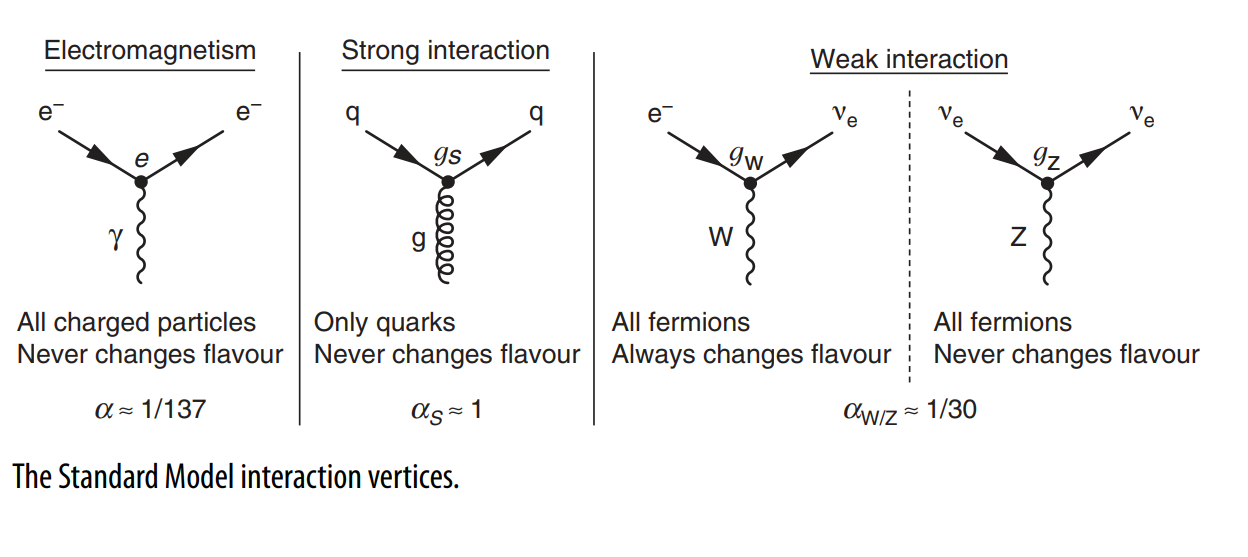
Standard Model interaction vertices
-
Only the weak interaction can change the flavor of fundamental particles.
-
The coupling constant $g$ characterizes the strength of each interaction vertex.
-
$\alpha \propto g^2$, and the probability is proportional to $g^4$.
Feynman’s Diagram
- Feynmann Diagramsrepresent all possible time-orderings in which a process such as $a+b \to c + d$ can occur.
- for each process considered, there will be an infinite number of Feynman diagrams that can be drawn. However, the diagrams that contains more vertices are suppressed by $\alpha^2$, adding two more vertices.
- backward arrows represent antiparticles, which accompany particles (denoted by forward arrows), in accordance with the conventions of the Standard Model.
Particle decays
- For a particle to decay there must be a final state with lower total rest mass that can be reached by a process with a Feynman diagram constructed from the Standard Model vertices.
- Decays of the fundamental particles all involve the weak charged current which has the only interaction vertex that allows for a change in flavor.
- hadronic states: baryon ($qqq$), antibaryon ($\bar q<div>\(\bar q\)</div>\bar q$), meson($q\bar q$).
- Each of these distinct states is observed as a particle with a particular mass, which is not just the sum of the masses of the constituent quarks, but includes a large contribution from the QCD binding energy.
- Hadronic states can be labelled by their flavor content, i.e. the type of quarks they contain, their total angular momentum $J$, and their parity $P$, which is an observable quantum number reflecting the symmetry of the wavefunction under the transformation $\vec r \to -\vec r$.
- stable states of hadrons: proton, neutron (relatively; in a nucleus)
- According to the numeric values of the alpha factors for interactions, if a particle can decay by the strong interaction this will almost always dominate over any possible electromagnetic or weak decay processes. Similarly, electromagnetic decay modes will dominate over weak interaction processes. So Particles where only weak decay processes are possible are relatively long-lived (at least in the context of particle physics).
Interactions of particles with matter
Interactions and detections with charged particles
Principles: detections of their ionization-loss energy
- Silicon detectors (np holes)
- Scintillator detectors (UV light)
- Cerenkov radiation
Interactions and detections of elections and photons
Principles: Braking radiation for low energy
- Electromagnetic shower
- Electromagnetic calorimeters
Interactions and detections of hadrons
More difficult to precise detection due to the variety of interactions
- Hadron calorimeters
Collider Experiments
At a particle accelerator, the colliding beams produce individual interactions referred to as events.
-
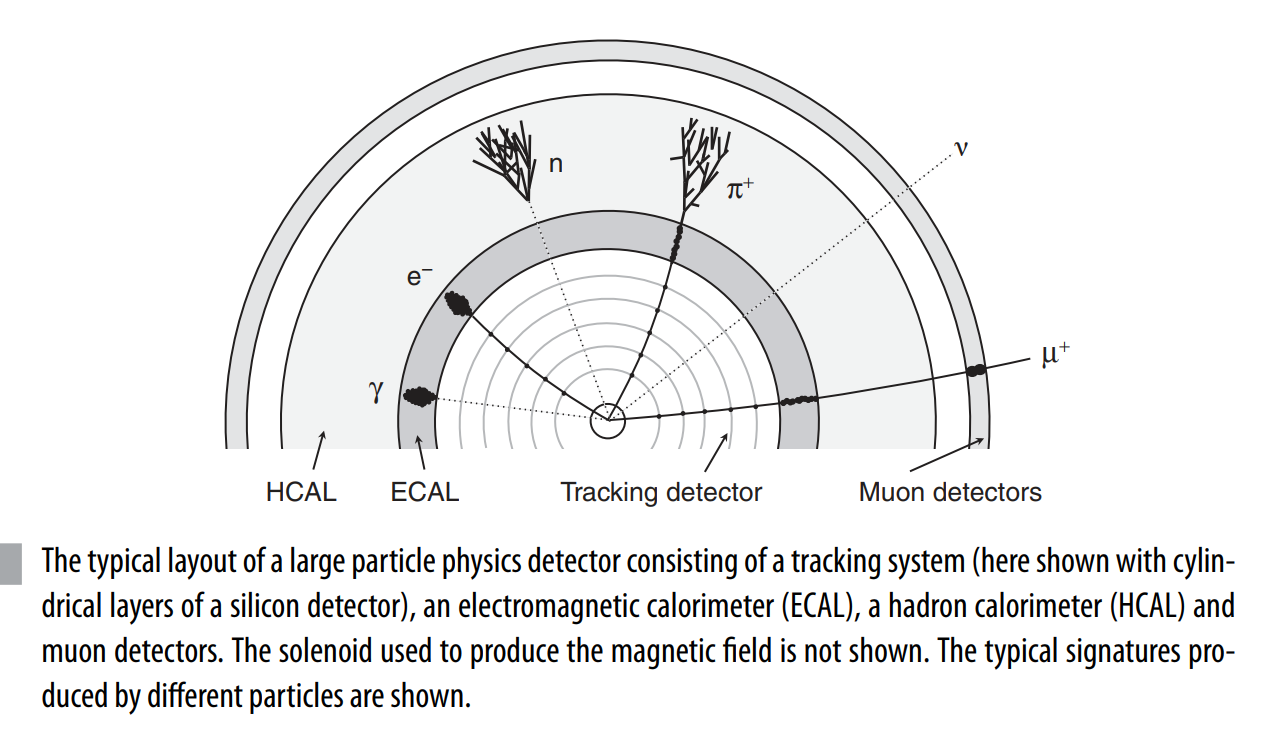
Setup of a track detector:
Detection of quarks
As a result of hadronization(quark combined to hadrons), each quark produced in a collision produces a jet of hadrons.
- Tagging of b-quarks: if a b-quark is produced, the hadronization process will create a jet of hadrons, one of which will contain the b-quark, for example a B0(bd) meson.
Measurements at particle accelerators
The most important features of an accelerator:
- center-of-mass energy$\sqrt s$
- instantaneous luminosity$\mathscr L$