Notebook Entry
Reading notes for Modern Particle Physics, Mark Thomson (Chapter 8)
Going back from a vacation… Continue to “fight against” particles!
Chapter 8 Deep inelastic scattering
Due to the finite proton size, elastic scattering at high $q^2$ is unlikely and inelastic reactions where the proton breaks up dominate.
Electron-proton inelastic scattering
The hadronic final state resulting from the break-up of the proton usually consists of many particles.
Kinematic variables for inelastic scattering
-
the invariant mass of the hadronic system, $W=p_4^2 = (p_2+q)^2$.
-
the negative four-momentum squared of the virtual photon, $Q^2 = -q^2$.
-
Bjorken $x$: $x = \frac {Q^2}{2p_2\cdot q }$
Apparently
For elastic interaction, $W=m_p^2$, thus $x =1$; for inelastic interaction, $W > m_p^2$, thus $0<x<1$.
-
$y = \frac{p_2\cdot q}{p_2\cdot p_1}$
Apparently
As $E_3<E_1$, $0<y<1$.
-
$v = \frac{p_2\cdot q}{m_p}$
Similar to y, we obtain
Relationships between kinematic variables:
Obviously we have
\[x = \frac{Q^2}{2m_pv}\]For a given center-of-mass $\sqrt s$:
\[s = (p_1+p_2)^2 = m_p^2+m_e^2+2E_1m_p\approx m_p^2+2E_1m_p\]Hence
\[E_1 = \frac{s-m_p^2}{2m_p}\]Therefore
\[y = \frac{2m_p}{s-m_p^2}v\]Thus
\[Q^2 = (s-m_p^2)xy\]
Inelastic scattering at low $Q^2$
For electron–proton scattering at relatively low electron energies, both elastic and inelastic scattering processes can occur.
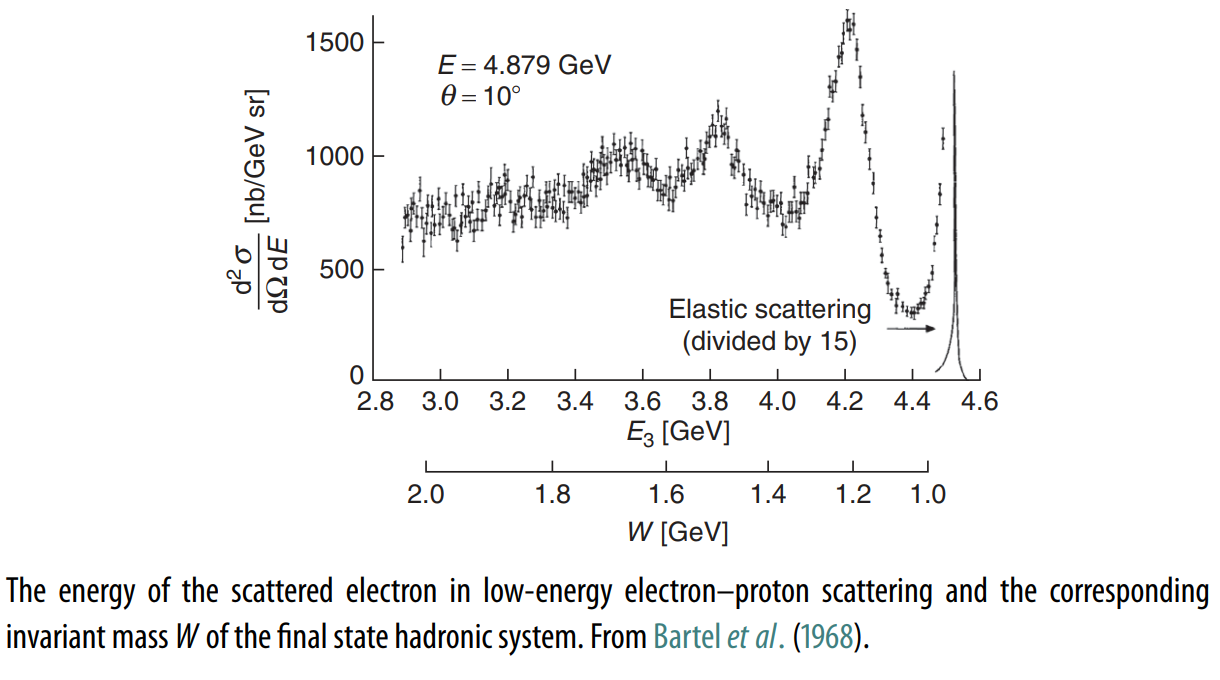
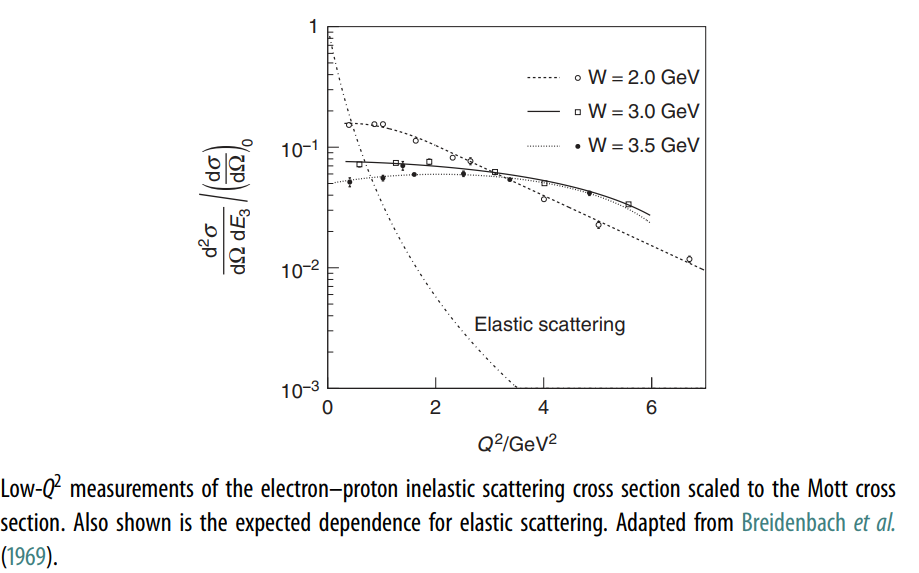
In the deep inelastic region (higher values of $W$), the near $Q^2$ independence of the cross section implies a constant form factor(describes the distribution of charges and magnetic momentum), from which it can be concluded that deep inelastic scattering occurs from point-like (or at least very small) entities within the proton.
Deep inelastic scattering
Rosenbluth formula in fixed-target frame for elastic scattering:
\[\frac{\mathrm d \sigma}{\mathrm d \Omega} = \frac{\alpha^2}{4 E_1^2\sin^4(\frac \theta 2)}\frac{E_3}{E_1}\left(\frac{G_E^2+\tau G_M^2}{1+\tau}\cos^2\frac \theta 2+2\tau G_M^2\sin^2\frac\theta 2\right)\]With \(Q^2 =2E_1E_3(1-\cos \theta) = 4E_1E_3\sin^2\frac \theta 2\)
\[Q^2 = 2m_p\cdot (E_1-E_3)\]and \(y = 1- \frac{E_3}{E_1}\) we obtain \(E_1 = \frac{Q^2}{2m_py};E_3 = \frac{Q^2(1-y)}{2m_py};\sin^2\frac \theta 2=\frac{m_p^2}{Q^2}\frac{y^2}{1-y}\) Plus \(Q^2 =\frac{2m_pE_1(1-\cos\theta)}{m_p+E_1(1-\cos\theta)}\) Therefore \(\frac{\mathrm d \sigma}{\mathrm d Q^2} = \frac{4\pi\alpha^2}{Q^4}\left[\frac{G_E^2+\tau G_M^2}{1+\tau}\left(1-y-\frac{m_p^2y^2}{Q^2}\right)+\frac 1 2 y^2 G_M^2\right] \\= \frac{4\pi\alpha^2}{Q^4}\left[\left(1-y-\frac{m_p^2y^2}{Q^2}\right)f_1(Q^2)+\frac 1 2 y^2 f_2(Q^2)\right]\)
Structure functions
For inelastic scattering:
\[\frac{\mathrm d \sigma}{\mathrm d x\mathrm d Q^2} = \frac{4\pi\alpha^2}{Q^4}\left[\left(1-y-\frac{m_p^2y^2}{Q^2}\right)\frac{F_1(x, Q^2)}{x}+y^2 F_2(x, Q^2)\right]\]For deep inelastic scattering, where $Q^2 \gg m_p^2y^2$:
\[\frac{\mathrm d \sigma}{\mathrm d x\mathrm d Q^2} = \frac{4\pi\alpha^2}{Q^4}\left[\left(1-y\right)\frac{F_2(x, Q^2)}{x}+y^2 F_1(x, Q^2)\right]\]Bjorken scaling and the Callan–Gross relation
The first observation, known as Bjorken scaling, was that both $F_1(x, Q^2)$ and $F_2(x, Q^2)$ are (almost) independent of $Q^2$, allowing the structure functions to be written as
\[F_1(x, Q^2) \to F_1(x) ;\quad F_2(x, Q^2) \to F_2(x)\]The second observation was that in the deep inelastic scattering regime , the two structure functions satisfy the Callan-Gross relation:
\[F_2(x) = 2xF_1(x)\]This observation can be explained by assuming that the underlying process in electron–proton inelastic scattering is the elastic scattering of electrons from point-like spin-half constituent particles within the proton, namely the quarks.
Electron–quark scattering
In the quark model, the underlying interaction in deep inelastic scattering is the QED process of $e^-q \to e^-q$ elastic scattering and the deep inelastic scattering cross sections are related to the cross section for this quark-level process.
Similar in e-p scattering, we have (in Chapter 5)
\[M_{fi} = \frac{Q_qe^2}{q^2}[\bar u(p_3)\gamma^\mu u(p_1)]g_{\mu\nu}[\overline u(p_4)\gamma^\nu u(p_2)]\]And(in Chapter 6)
\[\langle|M_{fi}|\rangle^2 = 2Q_q^2e^4\frac{s^2+u^2}{t^2} = 2Q_q^2e^4\frac{(p_1\cdot p_2)^2+(p_1\cdot p_4)^2}{(p_1\cdot p_3)^2}\]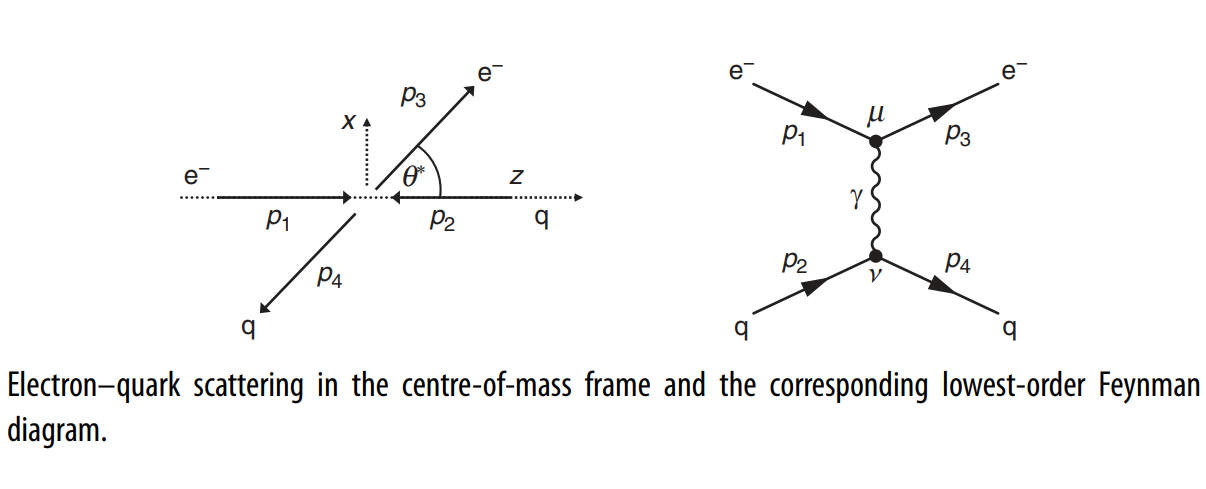
In the center-of-mass frame, we have
\[p_1 = (E, 0, 0, E)\\ p_2 = (E, 0, 0, -E)\\ p_3 = (E, E\sin \theta^*, 0, E\cos\theta^*)\\ p_4 = (E, -E\sin\theta^*, 0, -E\cos\theta^*)\]Thus
\[p_1\cdot p_2 = 2E^2\\ p_1\cdot p_3 = E^2(1-\cos\theta^*)\\ p_1\cdot p_4 = E^2(1+\cos\theta^*)\] \[\langle|M_{fi}|\rangle^2 = 2Q_q^2e^4\frac{(p_1\cdot p_2)^2+(p_1\cdot p_4)^2}{(p_1\cdot p_3)^2}= 2Q_q^2e^4\frac{4+(1+\cos\theta^*)^2}{(1-\cos\theta^*)^2}\] \[\frac{\mathrm d \sigma}{\mathrm d \Omega^*} =\frac{p_f^*}{64\pi^2sp_i^*}|M_{fi}|^2= \frac{Q_q^2e^4}{8\pi^2s}\frac{1+\frac 1 4(1+\cos\theta^*)^2}{(1-\cos\theta^*)^2}\]Lorentz-invariant form
\[\frac {\mathrm d \sigma}{\mathrm d q^2} =\frac{\mathrm d \sigma}{\mathrm d \Omega^*}\left|\frac{\mathrm d \Omega^*}{\mathrm d q^2}\right|\]where
\[t= q^2 = (p_1-p_3)^2=2E^2(1-\cos\theta^*), \Omega^* = 2\pi (1-\cos\theta^*),\left|\frac{\mathrm d \Omega^*}{\mathrm d q^2}\right|= \frac{2\pi}{2E^2} = \frac{2\pi}{s}= \frac{\pi}{p_i^{*2}}\]Thus
\[\frac {\mathrm d \sigma}{\mathrm d q^2} =\frac{1}{64\pi sp_i^{*2}}|M_{fi}|^2 =\frac{Q_q^2e^4}{32\pi sp_i^{*2}}\frac{(p_1\cdot p_2)^2+(p_1\cdot p_4)^2}{(p_1\cdot p_3)^2}= \frac{Q_q^2e^4}{8\pi q^4}\left(1+\frac{u^2}{s^2}\right)\]Plus(in Chapter 3)
\[s+t+u\approx 0\] \[\frac {\mathrm d \sigma}{\mathrm d q^2} = \frac{Q_q^2e^4}{8\pi q^4}\left(1+\frac{(s+q^2)^2}{s^2}\right)\]The quark-parton model
In the quark–parton model, the basic interaction in deep inelastic electron–proton scattering is elastic scattering from a spin-half quark within the proton, which is treated as a free particle in this process.
The quark–parton model for deep inelastic scattering is formulated in a frame where the proton has very high energy, $E \gg m_p$, referred to as the infinite momentum frame, where
- the mass of the proton can be neglected.
- i.e., the momentum of the struck quark(means the quark inside a hadron like a proton) transverse to the direction of motion of the proton can be neglected.
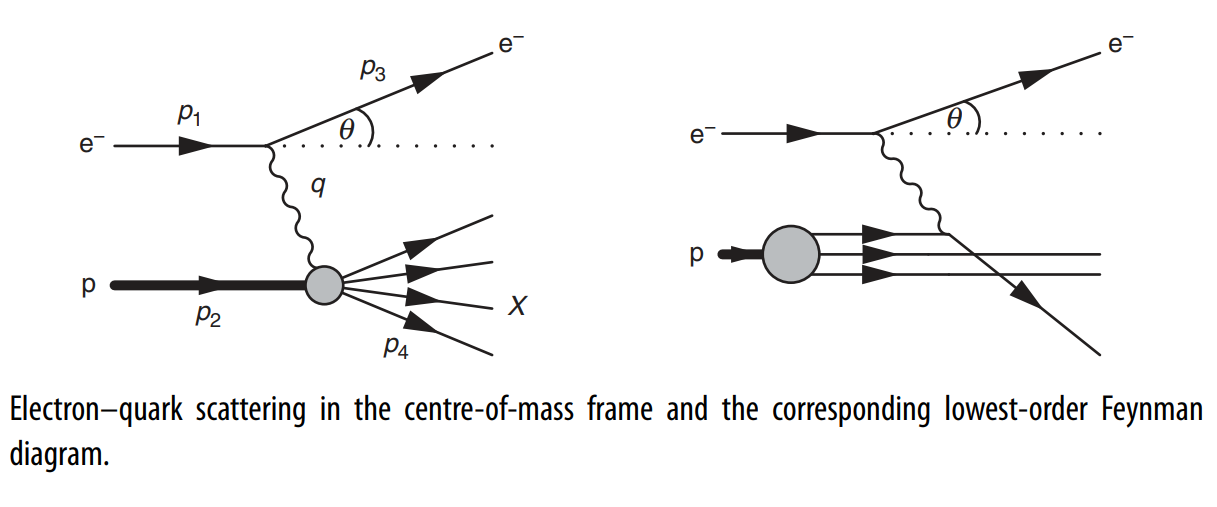
Therefore the 4-momentum for the struck quark
\[p_q = \xi p_2 = (\xi E_2, 0, 0, \xi E_2)\]Note that
\[m_q^2= (\xi p_2+q)^2 = \xi^2p_2^2+2\xi p_2\cdot q +q^2\approx 2\xi p_2\cdot q +q^2 \approx 0\]Thus
\[\xi = \frac {-q^2}{2p_2\cdot q}=\text{ (Bjorken) }x\]The relations between the kinetic variables of the e-p inelastic interaction and the e-q elastic interaction:
\[s_q = (p_1+\xi p_2)^2 = xs\\ y_q = \frac{\xi p_2\cdot q}{\xi p_2\cdot p_1}=y\\ x_q = \frac{Q^2}{2\xi p_2\cdot q} =1\]Thus the calculations for interactions between electrons and quarks can be useful here:
\[\frac {\mathrm d \sigma}{\mathrm d q^2} = \frac{Q_q^2e^4}{8\pi q^4}\left[1+\frac{(s_q+q^2)^2}{s_q^2}\right]\]With(Chapter 8)
\[q^2 = -(s_q-m_q^2)x_qy_q \approx -sy\]we have
\[\frac {\mathrm d \sigma}{\mathrm d q^2} = \frac{Q_q^2e^4}{8\pi q^4}\left[1+(1-y)^2\right]\]i.e.,
\[\frac{\mathrm d \sigma}{\mathrm d Q^2} = \frac{Q_q^2e^4}{4\pi Q^4}\left[(1-y)+\frac {y^2}{2}\right]\]Parton distribution functions
The quarks inside the proton will interact with each other through the exchange of gluons. The dynamics of this interacting system will result in a distribution of quark momenta within the proton. These distributions are expressed in terms of Parton Distribution Functions (PDFs). Say up-quark for example,
\[u^p(x)\delta x\]represents the number of up-quarks within the proton with momentum fraction between $x$ and $x + \delta x$(density of number).
According to the definition above, we have (with $\alpha = \frac {e^2} {4\pi}$)
\[\frac{\mathrm d \sigma}{\mathrm d x\mathrm d Q^2}= \frac{4\pi \alpha^2}{Q^4}\left[(1-y)+\frac{y^2}{2}\right]\sum_i Q_i^2 q_i^p(x)\]where the sum is calculated over all kinds of quarks.
Back to the structure of deep inelastic interaction(Chapter 8):
\[\frac{\mathrm d \sigma}{\mathrm d x\mathrm d Q^2} = \frac{4\pi\alpha^2}{Q^4}\left[\left(1-y\right)\frac{F_2(x, Q^2)}{x}+y^2 F_1(x, Q^2)\right]\]we have $F_1 = \frac 1 2\sum_i Q_i^2 q_i^p(x), \quad F_2 = x \sum_i Q_i^2 q_i^p(x), \quad F_2 = 2xF_1$.
This is due to the underlying process being elastic scattering from spin-half Dirac particles; the quark magnetic moment is directly related to its charge and therefore the contributions from the electromagnetic ($F_2$) and the pure magnetic ($F_1$) structure functions are fixed with respect to one another.
Determination of the parton distribution functions
In the static model of the proton, it is formed from two up-quarks and a down-quark, and it might be expected that only up- and down-quark PDFs would appear in this sum.
For proton,
\[F_2^{ep}(x) = x\left(\frac 4 9 u_p(x)+\frac 1 9d_p(x)+\frac 4 9\bar u_p (x)+\frac 1 9 \bar d_p (x)\right)\]Similarly for neutron,
\[F_2^{en}(x) = x\left(\frac 4 9 u_n(x)+\frac 1 9d_n(x)+\frac 4 9\bar u_n (x)+\frac 1 9 \bar d_n (x)\right)\]According to the isotope symmetry of proton and neutron, we have
\[d_p=u_n=u, d_n = u_p=u\]And
\[F_2^{ep}(x) = x\left(\frac 4 9 u(x)+\frac 4 9\bar u (x)+\frac 1 9d(x)+\frac 1 9 \bar d (x)\right)\] \[F_2^{en}(x) = x\left(\frac 1 9u(x)+\frac 1 9 \bar u (x)+\frac 4 9 d(x)+\frac 4 9\bar d (x)\right)\]Valence and sea quarks
The picture of a proton as a bound state consisting of three “valence” quarks is overly simplistic. The proton not only contains quarks, but also contains of a sea of virtual gluons that give rise to an antiquark component through $g \to q\bar q$ pair production.
(TO BE CONTINUED)
Electron–proton scattering at the HERA collider
(TO BE CONTINUED)