Notebook Entry
Reading notes for Modern Particle Physics, Mark Thomson (Chapter 10)
Chapter 10 Quantum Chromodynamics (QCD)
The local gauge principle
For QED process, we have
\[\mathrm i \gamma^\mu (\partial_\mu +\mathrm iqA_\mu)\psi = m\psi\]Consider $U(1)$ transformation, $\psi^\prime = \psi \mathrm e^{\mathrm i q \chi}$, we obtain
\[\mathrm i \gamma^\mu (\partial_\mu +\mathrm iqA_\mu^\prime )\psi^\prime = \mathrm e ^{\mathrm i q \chi}\cdot [\mathrm i \gamma^\mu (\partial_\mu +\mathrm iqA_\mu^\prime+\mathrm i q\partial _\mu\chi )\psi] = m\psi\mathrm e^{\mathrm i q\chi}\]In order to maintain the form of Dirac equation, we set
\[A_\mu ^\prime = A_\mu -\partial_\mu \chi\]as the gauge transformation.
From QED to QCD
Similarly for QCD process, we consider $SU(3)$ transformation, we have
\[\psi^\prime = \exp (\mathrm i g_S \alpha \cdot \hat T)\psi\]where $\hat T_i$ are $\hat T_i = \frac 1 2\lambda_i$ in Chapter 9.
Plus
\[\mathrm i \gamma^\mu\partial_\mu\psi^\prime =\mathrm i \gamma^\mu \cdot \exp (\mathrm i \alpha \cdot \hat T)(\partial_\mu+\mathrm i g_S\partial_\mu \alpha\cdot \hat T)\psi\]Hence the QCD field equation form has to be
\[\mathrm i \gamma^\mu (\partial_\mu +\mathrm i G^a _\mu \hat T^a)\psi = m\psi\]And the transformation for G
\[{G^k_\mu }^\prime = G_\mu^k-g_S\partial _\mu \alpha^k-g_Sf_{ijk}\alpha^iG^j_\mu\]Some notes:
- The upper indices denoted by Roman letters have nothing to do with covariance and contravariance, so there’s no difference between $T_i$ and $T^i$.
- This equation makes sense only when $\alpha_i \ll 1$ for i in 1-8.
where f is called structure constant for SU(3) group and satisfies
\[[\lambda_i, \lambda_j] = 2f_{ijk}\lambda_k\]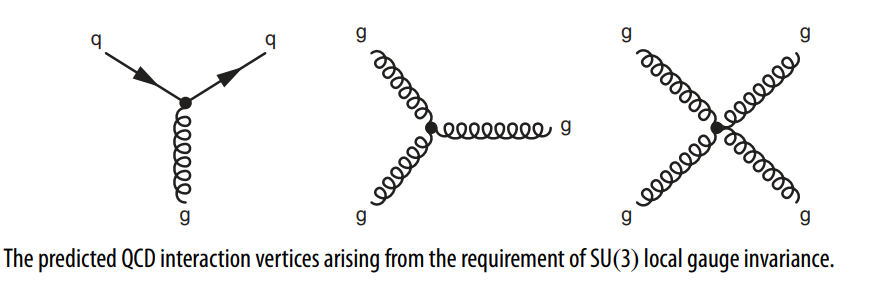
Color and QCD
Different form the QED process, the gluons of QCD process carry color charge, denoted by r, g, b.
Quark-gluon vertex
| interaction | gauge field | vertex factor |
|---|---|---|
| QED | $\mathrm i q\gamma^\mu A_\mu \psi$ | $-\mathrm i q\gamma^\mu A_\mu$ |
| QCD | $ \mathrm i g_S\frac 1 2\lambda^a\gamma^\mu G_\mu ^a\psi $ | $-\mathrm i g_S\frac 1 2\lambda^a\gamma^\mu$ |
And apparently the wave function for quarks need to be distinct by color charge:
\[j_q^\mu = \bar u (p_3)c_j^\dagger \cdot \left (-\frac 1 2 \mathrm i g_S\lambda^a\gamma^\mu \right)c_iu(p_1)\]Or
\[j_q^\mu = \left (-\frac 1 2 \mathrm i g_S\right)\cdot \left( c_j^\dagger \lambda^a c_i\right) \cdot [\bar u (p_3)\gamma^\mu u(p_1)] = \bar u (p_3)\left(-\frac 1 2\mathrm i g_s\lambda^a_{ji}\gamma^\mu \right)u(p_1)\\\text{(i.e. amplitude*vertex factor*amplitude)}\]And the gluon propgator
\[-\mathrm i \frac {g_{\mu\nu}}{q^2}\delta_{ab}\]Gluons
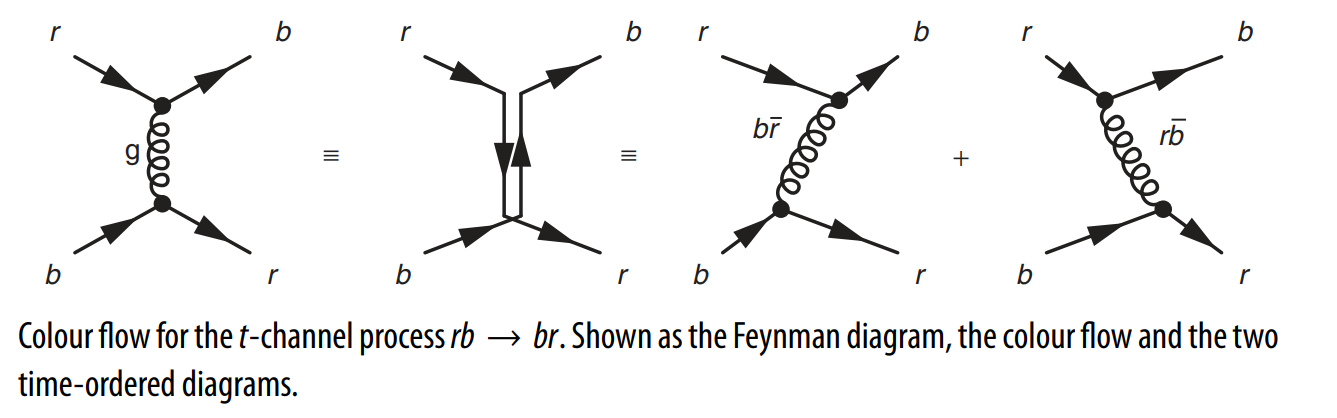
Because color is a conserved charge, the interaction involves the exchange of a $b\bar r$ gluon in the first time-ordering and a $r\bar b$ gluon in the second time-ordering.
The color assignments of the eight physical gluons can be written

Color confinement
Colored objects are always confined to color singlet states and that no objects with non-zero color charge can propagate as free particles.
Color confinement and hadronic states
SU(3) color singlet states are colorless combinations which have zero color quantum numbers, $I_3^c = Y^c = 0$. The action of any of the SU(3) color ladder operators on a color singlet state must yield zero, in which case the state is analogous to the spinless $\ket {0, 0}$ singlet state.
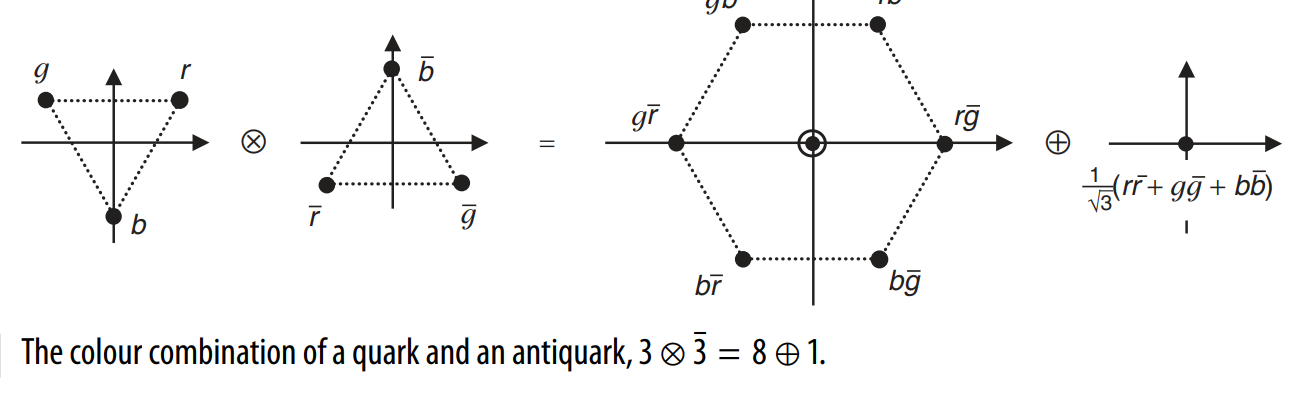
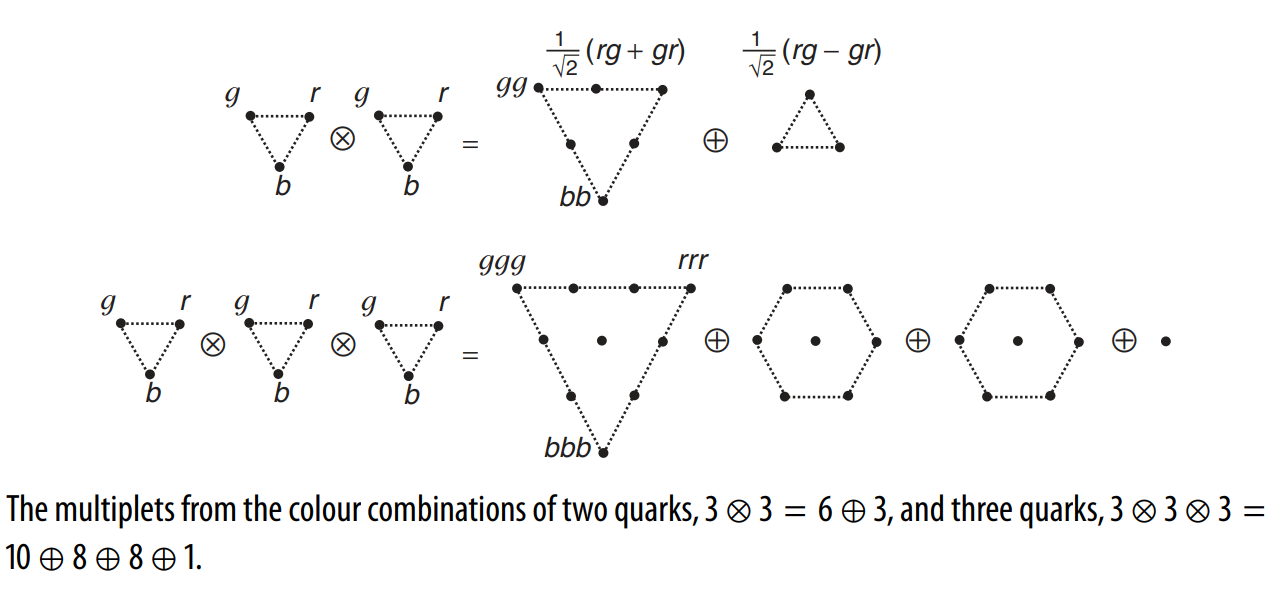
Singlet wavefunction for mesons$(q \bar q)$:
\[\psi^c = \frac 1 {\sqrt 3}(r\bar r+g\bar g+b\bar b)\]Singlet wavefunction for quarks$(qqq)$:
\[\psi^c = \frac 1 {\sqrt 6}(rgb-rbg+gbr-grb+brg-bgr)\]The color ladder operators can be used to confirm it is a color singlet.
Hadronization and jets
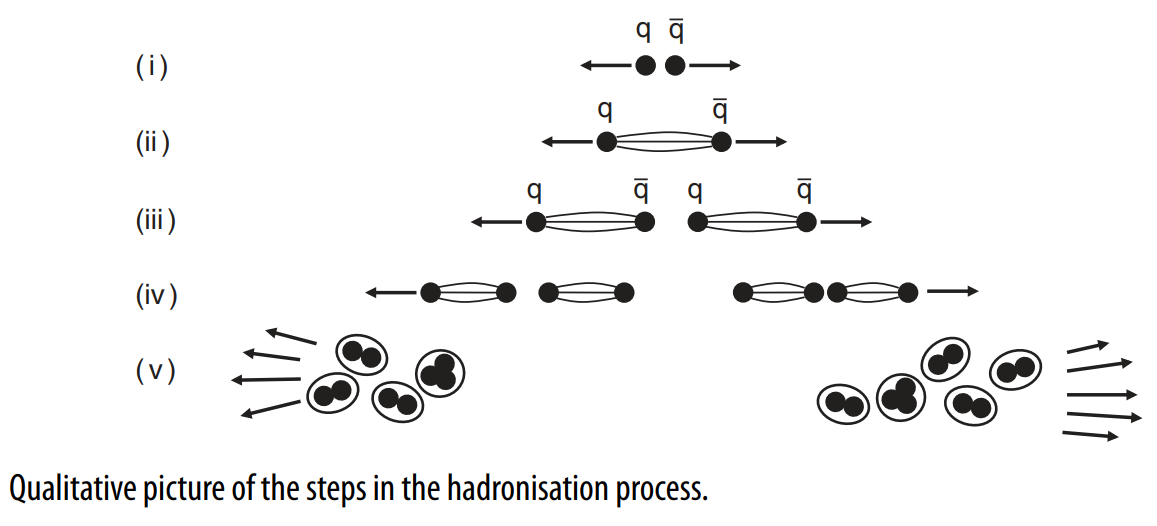
The five stages correspond to:
- the quark and antiquark produced in an interaction initially separate at high velocities;
- as they separate the color field is restricted to a tube with energy density of approximately $1 \text{GeV/fm}$;
- as the quarks separate further, the energy stored in the color field is sufficient to provide the energy necessary to form new $q\bar q$ pairs and breaking the color field into smaller “strings” is energetically favorable;
- this process continues and further $q\bar q$ pairs are produced until –
- all the quarks and antiquarks have sufficiently low energy to combine to form colorless hadrons.
Running of $\alpha_S$ and asymptotic freedom
At low-energy scales, the coupling constant of QCD is large, $\alpha_S \sim O(1)$. For this reason, it might seem problematic that perturbation theory cannot be applied in QCD processes because of the large value of $\alpha_S$ . Fortunately, it turns out that $\alpha_S$ is not constant; its value depends on the energy scale of the interaction being considered. At high energies, $\alpha_S$ becomes sufficiently small that perturbation theory can again be used.
(TO BE CONTINUED)
QCD in electron-positron annihilation
| Because the quark and antiquark will hadronize into jets of hadrons, it is not generally possible to identify experimentally which flavor of quark was produced. For this reason, the $e^+e^- \to q\bar q$ cross section is usually expressed as an inclusive sum over all quark flavors, $e^+e^- \to \text{hadrons}$. Furthermore, it is also not usually possible to identify which jet came from the quark and which jet came from the antiquark. To reflect this ambiguity, the differential cross section is usually quoted in terms of $ | \cos θ | $. |
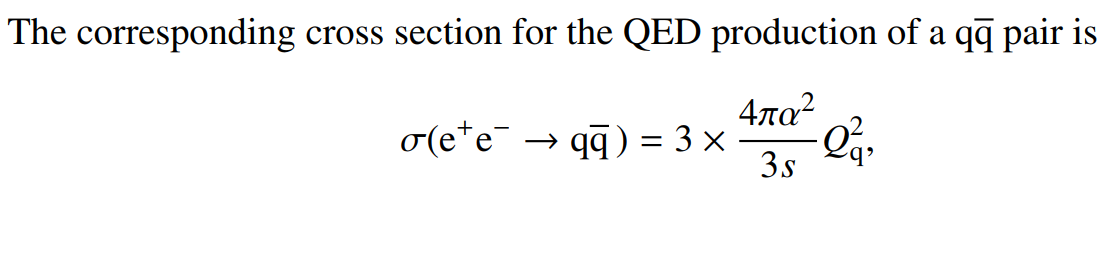
where the factor of three accounts for the sum over the three possible color combinations of the final-state $q\bar q$ that can be produced as $g\bar g$, $r\bar r$ or $b\bar b$.
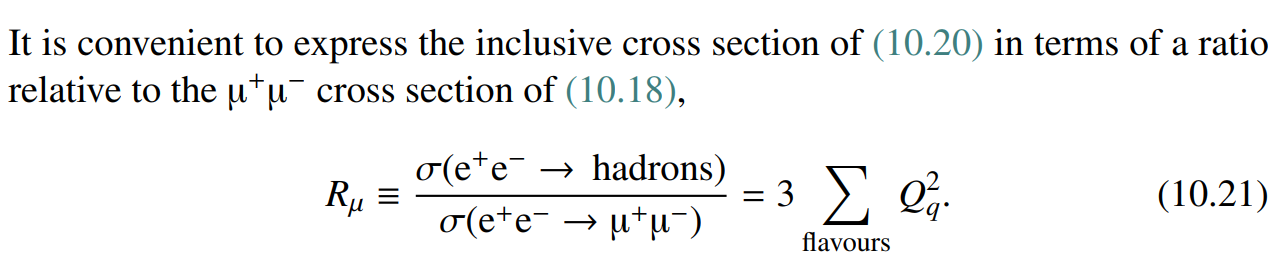
Color factors
Heavy mesons and the QCD color potential
Hadron–hadron collisions 4
(TO BE CONTINUED)