Notebook Entry
Reading notes for Modern Particle Physics, Mark Thomson (Chapter 11)
Chapter 11 The weak interaction
The weak charged-current interaction
The charged-current weak interaction is mediated by massive charged $W^\pm$ bosons and consequently couples together fermions differing by one unit of electric charge. It is also the only place in the Standard Model where parity is not conserved.
Parity
Intrinsic parity
For Dirac spinors, $\hat P = \gamma^0$ and $\hat P\hat P = I$.
Parity conservation in QED
Let’s verify the law of conservation of parity in QED process:
For a QED process,
\[M = \frac{Q_qe^2}{q^2}j_e\cdot j_q =\frac{Q_qe^2}{q^2}g_{\mu\nu}j_e^\mu j_q^\nu\]And
\[j_e^\mu = \bar u(p_3)\gamma^\mu u(p_1)\\ j_q^\nu = \bar u(p_4)\gamma^\nu u(p_2)\]For parity transformation,
\[u^\prime = \gamma^0 u\\ \bar {u^\prime} = u{^\prime}^\dagger\gamma^0 = u^\dagger \gamma^0\gamma^0 = \bar u \gamma^0\]Thus
\[{j_e^\prime}^0 = \bar{u^\prime}(p_3)\gamma^0 u^\prime(p_1) = \bar u(p_3)\gamma^0\gamma^0\gamma^0 u(p_1)= \bar u(p_3)\gamma^0 u(p_1)\\ {j_e^\prime}^i = \bar{u^\prime}(p_3)\gamma^i u^\prime(p_1) = \bar u(p_3)\gamma^0\gamma^i\gamma^0 u(p_1)= -\bar u(p_3)\gamma^i u(p_1)\]Similarly,
\[j_q^0 = \bar u(p_4)\gamma^0 u(p_2)\\ j_q^i = \bar u(p_4)\gamma^i u(p_2)\]Therefore
\[j_e^\prime\cdot j_q^\prime = j_e^0j_q^0-\sum_{i=1}^3(-j_e^i)(-j_q^i) = j_e\cdot j_q\]Thus
\[M^\prime=M\]This invariance implies that parity is conserved in QED.
Analogously parity is conserved in QCD.
Scalars, pseudoscalars, vectors and axial vectors
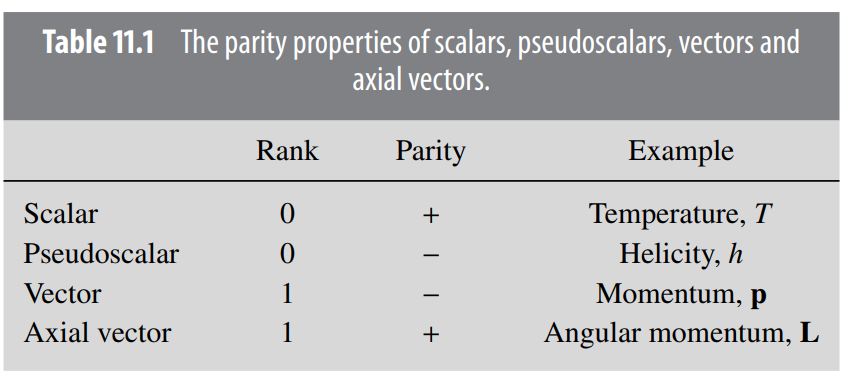
Helicity: $h \propto S\cdot p $.
Parity violation in nuclear β-decay
Wu’s experiment.
V-A structure of the weak interaction
It turns out that there are only five combinations of individual $\gamma$-matrices that have the correct Lorentz transformation properties, such that they can be combined into a Lorentz-invariant matrix element.
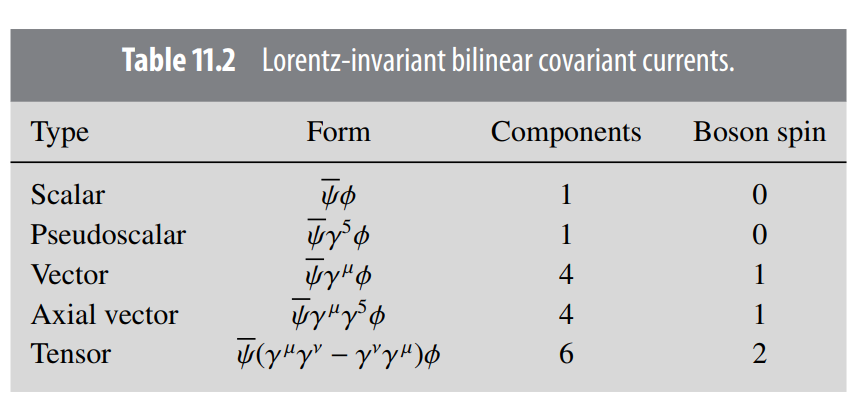
where $\gamma^5 = \gamma^0\gamma^1\gamma^2\gamma^3$ measures the chirality.
If this is restricted to the exchange of a spin-1 (vector) boson, the most general form for the interaction is a linear combination of vector and axial vector currents,
\[j^\mu \propto g_V\bar u(p^\prime)\gamma^\mu u(p)+g_a\bar u(p^\prime)\gamma^\mu\gamma^5u(p)\]For weak interaction process, we have
\[j^\mu = \frac {g_W} {\sqrt 2} \bar u(p^\prime)\frac 1 2\gamma^\mu (1-\gamma^5)u(p)\]Chiral structure of the weak interaction
It is obvious that
\[j^\mu = \frac {g_W} {\sqrt 2} \bar u(p^\prime)\gamma^\mu P_Lu(p) = \frac {g_W} {\sqrt 2} \overline {P_L u(p^\prime)}\gamma^\mu u(p)\]So the interaction apparently only involves left-handed particles., thus the parity is not conserved in this process.
The W-boson propagator
The original propagator is plausibly
\[\frac 1 {q^2-m_W^2}\]After considering all the polarization,
\[\frac{-\mathrm i }{q^2-m_W^2}\left(g_{\mu\nu}-\frac {q_\mu q_\nu}{m_W^2}\right)\]Fermi theory
\[M = -\left[\frac {g_W} {\sqrt 2} \bar \psi_3\frac 1 2\gamma^\mu (1-\gamma^5)\psi_1\right] \cdot \frac{1}{q^2-m_W^2}\left(g_{\mu\nu}-\frac {q_\mu q_\nu}{m_W^2}\right) \cdot \left[\frac {g_W} {\sqrt 2} \bar \psi_4\frac 1 2\gamma^\mu (1-\gamma^5)\psi_2\right]\]when $q \ll m_W^2$, we have
\[M = \frac{g_W^2}{8} \cdot \left[ \bar \psi_3\gamma^\mu (1-\gamma^5)\psi_1\right] \cdot \frac{g_{\mu\nu}}{m_W^2} \cdot \left[ \bar \psi_4\gamma^\mu (1-\gamma^5)\psi_2\right]\]And the Fermi constant
\[G_F =\frac{\sqrt 2\,g_W^2}{8}\]Helicity in pion decay
(TO BE CONTINUED)
Experimental evidence for $V – A$
(TO BE CONTINUED)