Notebook Entry
Reading notes for Modern Particle Physics, Mark Thomson (Chapter 12)
Chapter 12 The weak interactions of leptons
Lepton universality
Within the accuracy of the experimental measurements, it can be concluded that $G^{(e)}_F = G^{(\mu)}_F = G^{(\tau)}_F$, providing strong experimental evidence for the lepton universality of the weak charged current; there is a universal coupling strength at the $Weν_e$, $Wμν_μ$ and $Wτν_τ$ interaction vertices.
Neutrino scattering
Let’s consider the deep inelastic interaction with neutrinos and partons.
Neutrino-quark scattering cross section
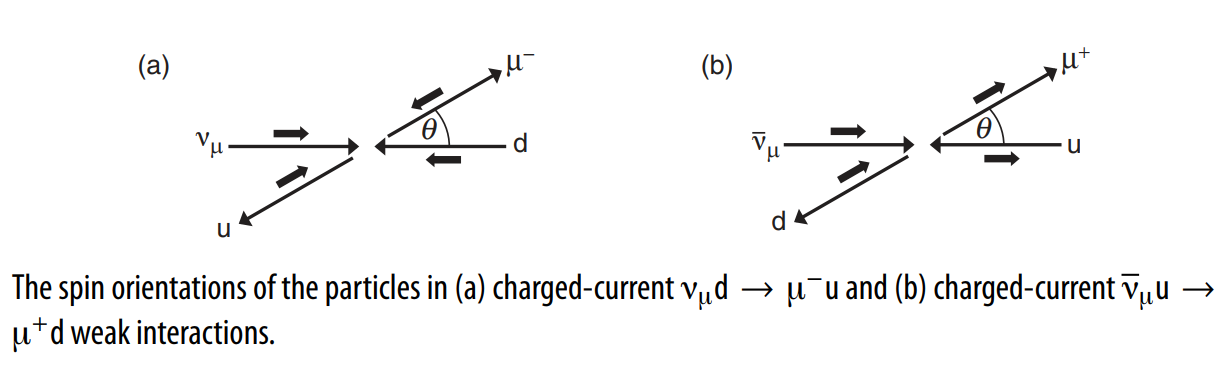
With $Q^2 \ll m_W^2$, we have
\[M = \frac{g_W^2}{2}\cdot \left[ \bar u(p_3)\gamma^\mu P_Lu(p_1)\right]\cdot \frac{g_{\mu\nu}}{m_W^2}\cdot \left[ \bar u(p_4)\gamma^\mu P_L u(p_2)\right]\]In the center-of-mass frame, we have (Chapter 4)
\[u_\uparrow =N \begin{bmatrix} c\\ s \mathrm e ^{\mathrm i \phi}\\ c\\ s \mathrm e ^{\mathrm i \phi}\\ \end{bmatrix}, \quad u_\downarrow =N \begin{bmatrix} -s\\ c \mathrm e ^{\mathrm i \phi}\\ s\\ -c \mathrm e ^{\mathrm i \phi}\\ \end{bmatrix},\quad v_\uparrow =N \begin{bmatrix} s\\ - c \mathrm e ^{\mathrm i \phi}\\ -s\\ c \mathrm e ^{\mathrm i \phi}\\ \end{bmatrix}, \quad v_\downarrow =N \begin{bmatrix} c\\ s \mathrm e ^{\mathrm i \phi}\\ c\\ s \mathrm e ^{\mathrm i \phi}\\ \end{bmatrix}\]Apparently only the LH charity states give the non-zero results, therefore:
\[u_\downarrow(p_1) = \sqrt E \begin{bmatrix} 0\\ 1\\ 0\\ -1 \end{bmatrix},\quad u_\downarrow(p_2) = \sqrt E \begin{bmatrix} -1\\ 0\\ 1\\ 0 \end{bmatrix}, \quad u_\downarrow(p_3) = \sqrt E \begin{bmatrix} -s\\ c\\ s\\ -c \end{bmatrix}, \quad u_\downarrow(p_4) = \sqrt E \begin{bmatrix} -c\\ -s\\ c\\ s \end{bmatrix}\]where $c = \cos \frac{\theta^{\ast}}{2}, s = \sin\frac{\theta^{\ast}}{2}$, and $\theta^{\ast}$ denotes the angle of z-axis in the center-of-mass frame.
Thus
\[j_l^\mu = \bar u(p_3)\gamma^\mu P_Lu(p_1) = \bar u(p_3)\gamma^\mu u(p_1) = 2E(c, s, -\mathrm is , c)\\ j_q^\nu = \bar u(p_4)\gamma^\mu P_L u(p_2) = 2E(c, -s, -\mathrm i s, -c)\] \[M = \frac{g_W^2}{2}\cdot j_l^\mu\cdot \frac{g_{\mu\nu}}{m_W^2}\cdot j_q^\nu = \frac{2g_W^2E^2}{m_W^2}(c^2+s^2+s^2+c^2) = \frac{4g_W^2E^2}{m_W^2} = \frac{g_W^2s^*}{m_W^2}\]where $s^* = 2E$.
Because both the quark and neutrino are left-handed, the interaction occurs in an $S_z = 0$ state and thus there is no preferred polar angle in the center-of-mass frame.
As for the cross section,
\[\frac{\mathrm d \sigma}{\mathrm d \Omega^*} =\frac{1}{64\pi^2s^*}\langle|M_{fi}|^2\rangle\]where
\[\langle|M_{fi}|^2\rangle = \frac 1 2 \left(\frac{g_W^2s^*}{m_W^2}\right)^2\]Thus
\[\frac{\mathrm d \sigma_{\nu q}}{\mathrm d \Omega^*} =\frac{1}{64\pi^2s^*}\langle|M_{fi}|^2\rangle =\left(\frac{g_W^2}{8\sqrt 2\pi m_W^2}\right)^2 s^* = \frac {G_F^2}{4\pi^2}s^*\]And
\[\sigma_{\nu q} = \frac {G_F^2}{\pi}s^*\]Antineutrino-quark scattering
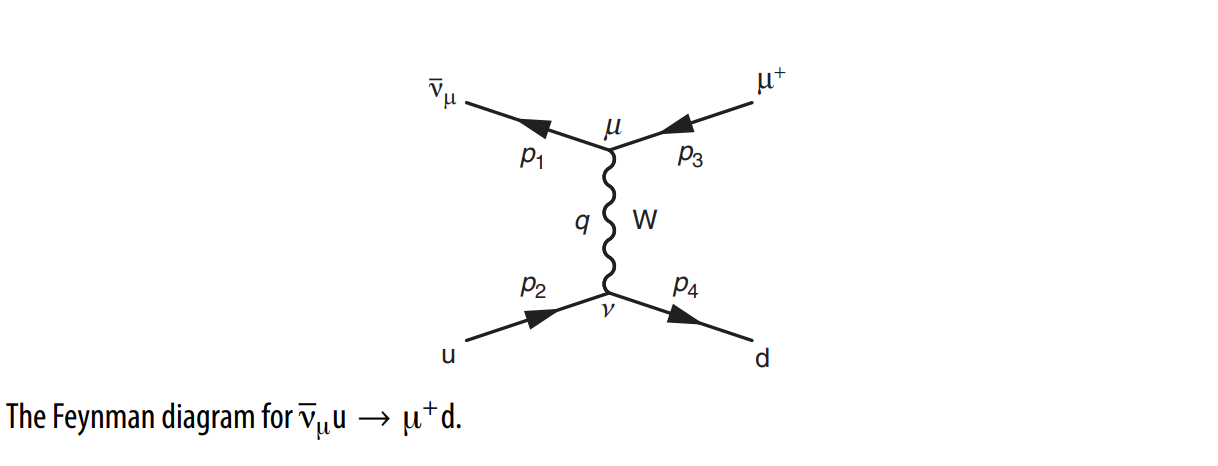
\[\langle|M_{fi}|^2\rangle = \frac 1 2 \left(\frac{g_W^2s^*}{m_W^2}\right)^2\cdot \frac 1 4 (1+\cos\theta^*)^2\] \[\frac{\mathrm d \sigma_{\bar \nu q}}{\mathrm d \Omega^*} = \frac{1}{64\pi^2s^*}\langle|M_{fi}|^2\rangle =\left(\frac{g_W^2}{8\sqrt 2\pi m_W^2}\right)^2 s^* \cdot \frac 1 4 (1+\cos\theta^*)^2 = \frac {G_F^2}{4\pi^2}s^*\cdot \frac 1 4 (1+\cos\theta^*)^2\] \[\sigma_{\bar \nu q} =\frac {G_F^2}{3\pi}s^*\]The origin of this difference can be understood in terms of spins of the particles. The $V - A$ nature of the weak interaction means that the $\bar \nu q$ interaction occurs in an $S_z = 1$ state and this results in an angular dependence of the matrix element of $\frac 1 2 (1 + \cos \theta^*)$.
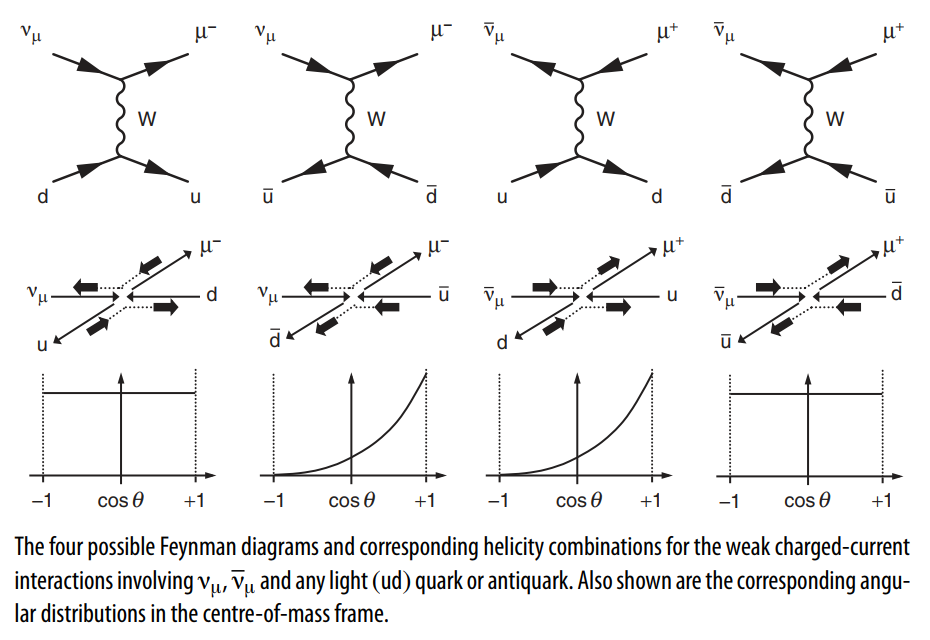
Neutrino–nucleon differential cross sections
The Lorentz invariant form of differential cross section:
\[y = \frac{p_2\cdot q}{p_2\cdot p_1} = \frac{p_2\cdot (p_1-p_3)}{p_2\cdot p_1}\]where
\[p_1 = (E, 0, 0 ,E)\\ p_2 = (E, 0, 0, -E)\\ p_3 = (E, E\sin\theta^*, 0, E\cos\theta^*)\] \[y = \frac12(1-\cos\theta^*)\]Therefore
\[\frac{\mathrm d \sigma_{\nu q}}{\mathrm d y} =\frac{\mathrm d \sigma_{\nu q}}{\mathrm d \Omega^*}\left|\frac{\mathrm d \Omega^*}{\mathrm d y}\right| = \frac{G_F^2}{4\pi^2}s^*\cdot 4\pi = \frac {G_F^2}{\pi}s^*\]and
\[\frac{\mathrm d \sigma_{\bar \nu q}}{\mathrm d y} =\frac{\mathrm d \sigma_{\nu q}}{\mathrm d \Omega^*}\left|\frac{\mathrm d \Omega^*}{\mathrm d y}\right| = \frac{G_F^2}{4\pi^2}s^*\cdot \frac 1 4 (1+\cos\theta^*)^2\cdot 4\pi = \frac {G_F^2}{\pi}(1-y)^2 s^*\]Neutrino deep inelastic scattering
Let’s integregate the neutrino-quark interaction calculation into Feynman’s parton model.
\[\frac{\mathrm d \sigma_{\nu p}}{\mathrm d y_q}=\frac {G_F^2}{\pi}s^*\cdot (d(x)+(1-y_q^2)\bar u(x))\mathrm d x\]where
\[s^* = (p_1+xp_2)^2 = xs\]and
\[y_q = \frac{x p_2\cdot q}{p_1\cdot xp_2} = y\]i.e.,
\[\frac{\mathrm d \sigma_{\nu p}}{\mathrm d x\mathrm d y}=\frac {G_F^2}{\pi}sx(d(x)+(1-y)^2\bar u(x))\]Analogously
\[\frac{\mathrm d \sigma_{\bar \nu p}}{\mathrm d x\mathrm d y}=\frac {G_F^2}{\pi}sx(u(x)+(1-y)^2\bar d(x))\]and
\[\frac{\mathrm d \sigma_{\nu n}}{\mathrm d x\mathrm d y}=\frac {G_F^2}{\pi}sx(u(x)+(1-y)^2\bar d(x))\] \[\frac{\mathrm d \sigma_{\bar \nu n}}{\mathrm d x\mathrm d y}=\frac {G_F^2}{\pi}sx(d(x)+(1-y)^2\bar u(x))\]due to the symmetry of proton ande neutron.
For nucleur $N$ with the same number of protons and neutrons, we have
\[\frac{\mathrm d^2 \sigma_{\nu N}}{\mathrm d x\mathrm d y}=\frac 1 2\left(\frac{\mathrm d \sigma_{\nu p}}{\mathrm d x\mathrm d y}+\frac{\mathrm d \sigma_{\nu n}}{\mathrm d x\mathrm d y}\right)=\frac {G_F^2m_N}{\pi}E_{\nu}x[u(x)+d(x)+(1-y)^2(\bar u(x)+\bar d(x))]\]And
\[\frac{\mathrm d \sigma_{\nu N}}{\mathrm d y}=\frac 1 2\left(\frac{\mathrm d \sigma_{\nu p}}{\mathrm d x\mathrm d y}+\frac{\mathrm d \sigma_{\nu n}}{\mathrm d x\mathrm d y}\right)=\frac {G_F^2m_N}{\pi}E_{\nu}[f_q+(1-y)^2f_{\bar q}]\]where $f_q$ represents the intergral of x, same as the other f-term.
Neutrino scattering experiments
(TO BE CONTINUED)
Structure functions in neutrino interactions
For QED deep inelastic interaction, we have
\[\frac{\mathrm d \sigma}{\mathrm d x\mathrm dy} = \frac{4\pi\alpha^2s}{Q^4}\left[\left(1-y\right){F_2(x, Q^2)}+xy^2 F_1(x, Q^2)\right]\]For weak interaction, we have the structure function
\[\frac{\mathrm d \sigma}{\mathrm d x\mathrm dy} = \frac{G_F^2s}{2\pi}\left[\left(1-y\right){F_2(x, Q^2)}+xy^2 F_1(x, Q^2)+y(1-\frac y 2)xF_3(x, Q^2)\right]\]According to parton model for proton,
\[F_2 = 2xF_1 = 2x(d(x)+\bar u(x))\\ F_3 = 2(d(x)-\bar u(x))\]Charged-current electron–proton scattering
(TO BE CONTINUED)